3.6 Applying corrections
Now that our sync-tag diagnostic plots look quite good, we can apply the corrections to our Detectionslist object.
# Create corrected detections dataset
detlst_corr <- synchronize(exdata_clocksync, sync_model)

# Plot sync-tag diagnostics
sync_lat <- SyncTagLatency(detlst_corr)
c <- transmission_speed(sync_model)
plot(sync_lat, transmission_speed = c)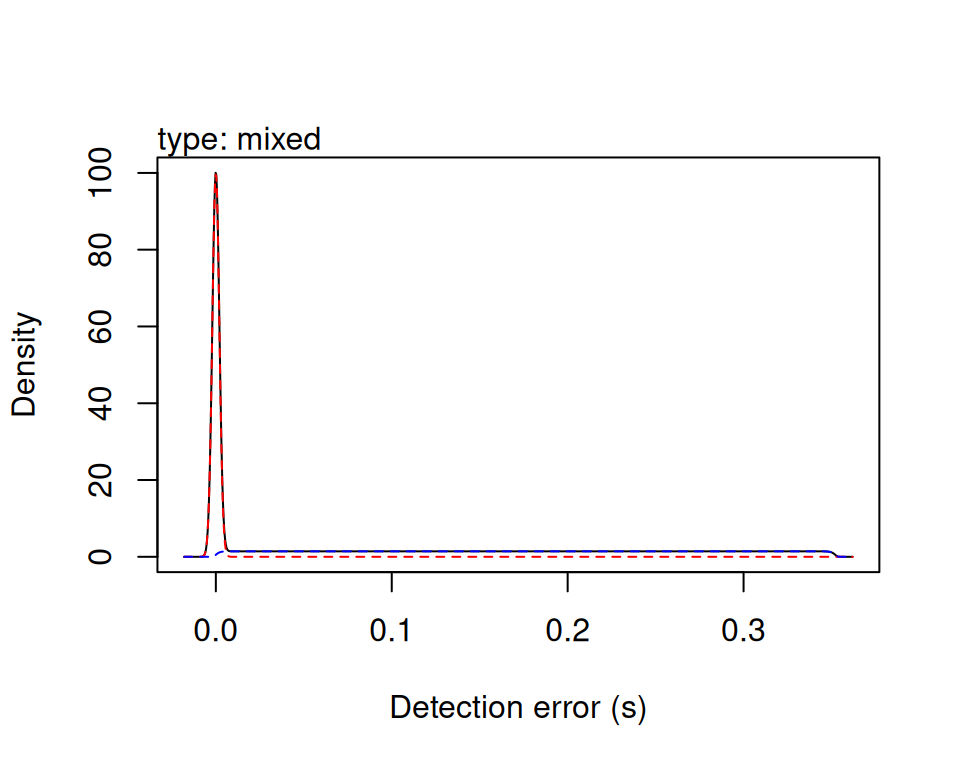
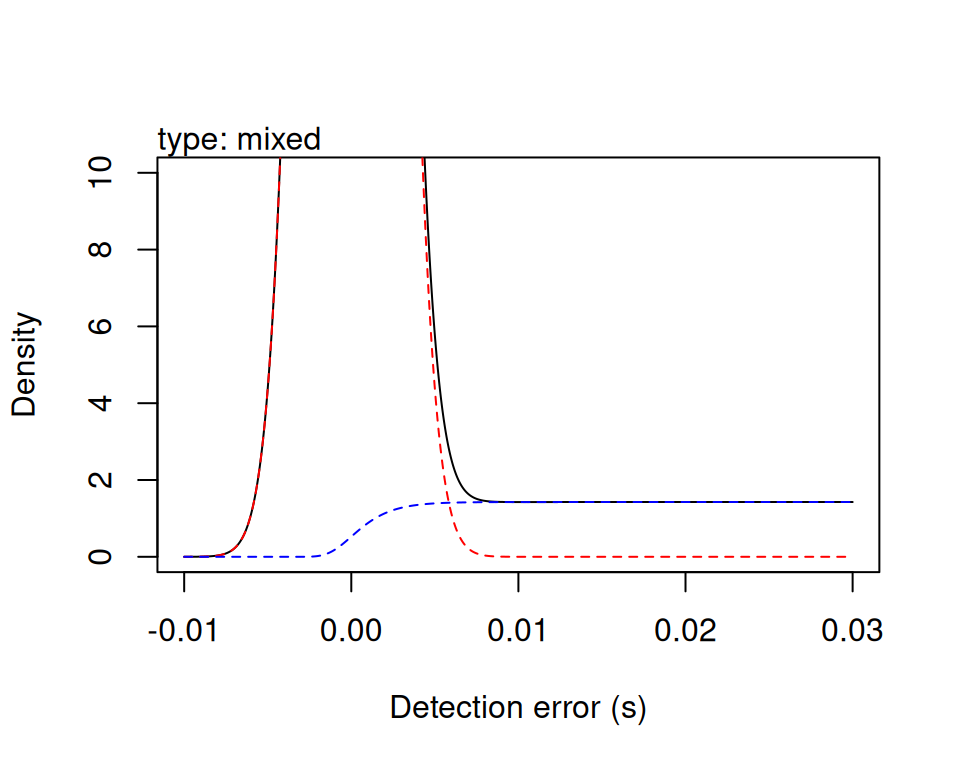
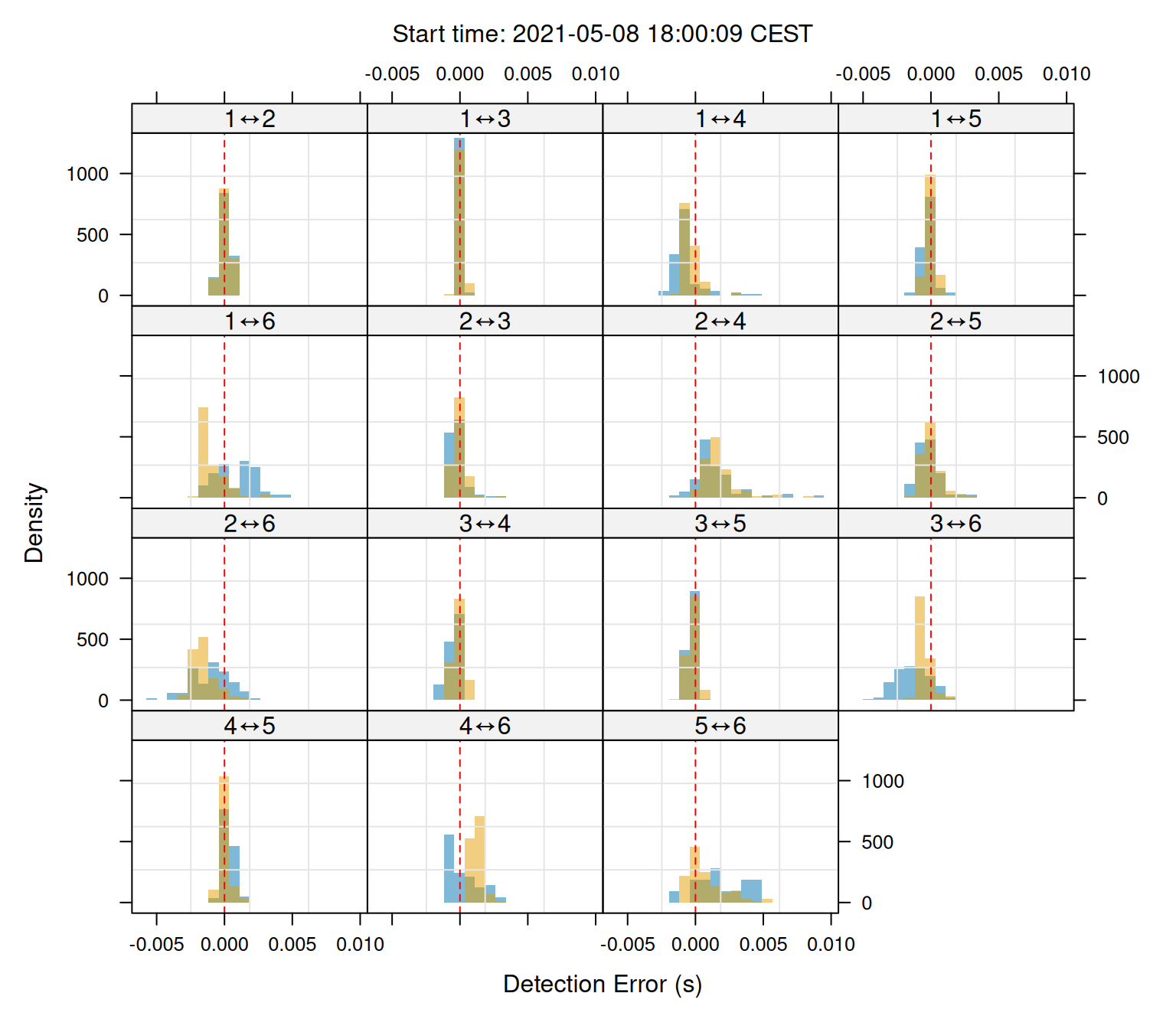
We now have sync-tag transmission values that match well with our expectations. We can now apply telemetry positioning models to this data set.
Lastly, it can be useful to use the sync-tags to take empirical measures of your detection error. This detection error distribution can be later used in telemetry positioning models.
This can be easily done with the detection_error function.
Below we’ll (i) extract the sync-tag detection error values, then (ii) fit a mixed detection error distribution (ddetect) to those values.
# Extract detection error for SyncTagLatency object
det_err <-  detection_error(sync_lat, transmission_speed = c)
head(det_err); tail(det_err)
## pair path detection_error
## 1 1↔2 1⟶2 0.0003758118
## 2 1↔2 1⟶2 0.0005260413
## 3 1↔2 1⟶2 0.0002764492
## 4 1↔2 1⟶2 0.0009756103
## 5 1↔2 1⟶2 0.0001930688
## 6 1↔2 1⟶2 0.0001580417## pair path detection_error
## 3171 5↔6 6⟶5 0.0001278360
## 3172 5↔6 6⟶5 0.0026903073
## 3173 5↔6 6⟶5 0.0004433656
## 3174 5↔6 6⟶5 0.0009687652
## 3175 5↔6 6⟶5 0.0007263575
## 3176 5↔6 6⟶5 0.0006256373# Get histogram of empirical detection error distribution
hist <- hist(det_err$detection_error, plot = F, breaks = 50)
# Set phi to double the largest detection error value
phi <- max(det_err$detection_error, na.rm = T) * 2
# Fit the sigma parameter
res <- optim(
par = c(sigma = 0.1), method = "Brent",
lower = 0, upper = 1,
fn = \(par){
# Get negative log likelihood
ret <- -ddetect(
x = na.omit(det_err$detection_error),
sigma = par[1], phi = phi,
log = T) |> sum()
})
sigma <- res$par
message(sprintf("Fitted detection error \u03c3: %.5f s", sigma))## Fitted detection error σ: 0.00088 s# Get fitted detection error distribution
x_rng <- range(det_err$detection_error, na.rm = T)
x <- seq(x_rng[1], x_rng[2], by = 1e-4)
y <- ddetect(x = x, sigma = sigma, phi = phi)
# Plot fitted vs. empirical detection error
ymax <- max(c(hist$density, y))
plot(NULL, xlim = range(x_rng), ylim = c(0, ymax),
ylab = "Density", xlab = "Detection error (s)")
lines(hist$mids, hist$density, type = "h", col = "steelblue")
lines(x,y, lty = 2, col = "tomato")
legend(x = "topright",
legend = c("Measured detection error", "Fitted detection error"),
col = c("steelblue", "tomato"), lty = c(1,2))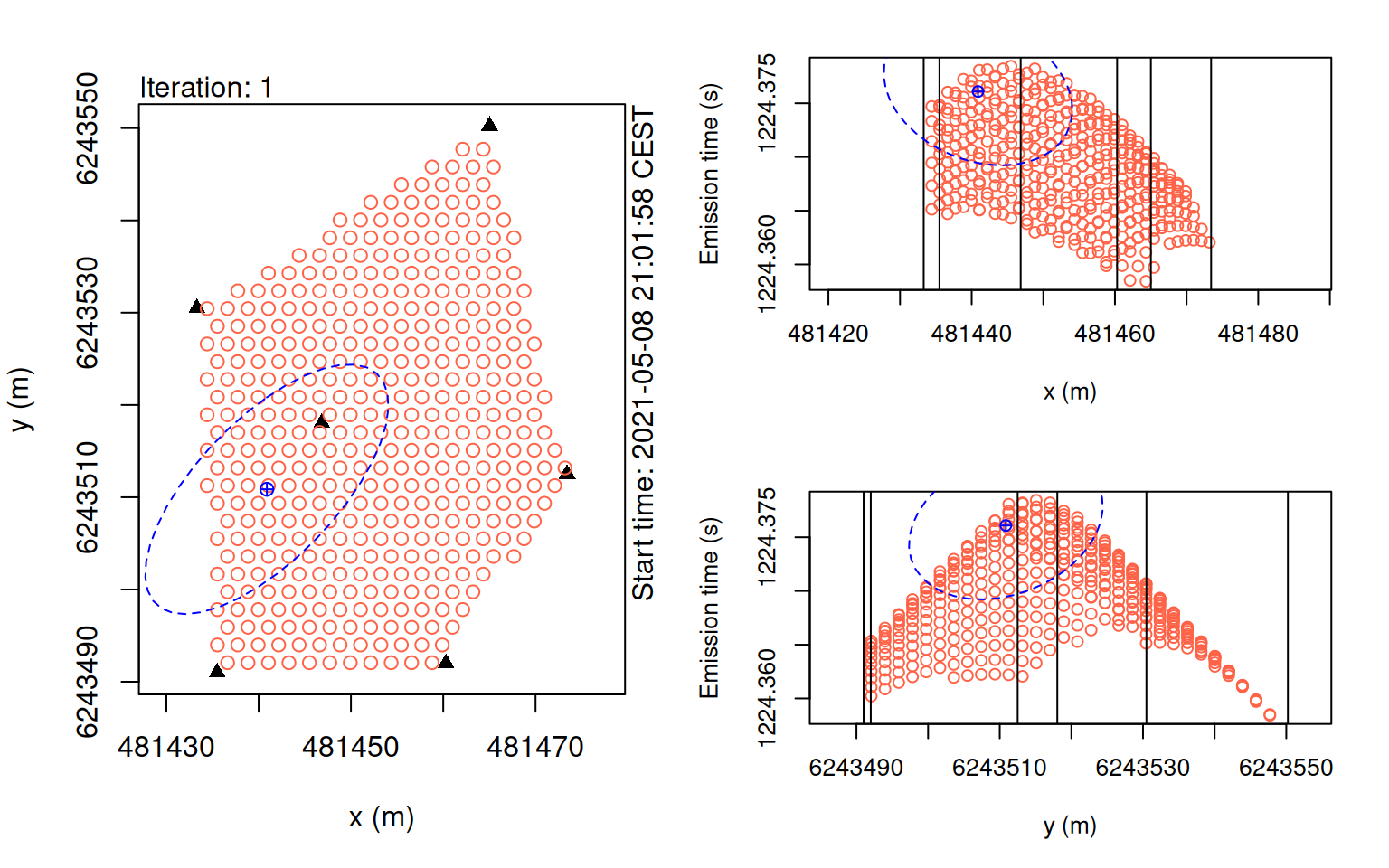
The above values for phi and sigma can be used with the KaltoaPointPositioning function.